
WHAT IS THE SYSTEM OF POSITIVE BEHAVIORAL INTERVENTION AND SUPPORTS?
Positive Behavior Support (PBS) is a multi-tiered system of positive strategies and expectations to support the behavior of all students. It is research-based strategies designed to prevent the problem behavior while teaching socially appropriate alternative behaviors. PBS are identified according to tier, similar to the tiers used for academic Response to Intervention (RTI):
Positive Behavior Support (PBS) is a multi-tiered system of positive strategies and expectations to support the behavior of all students. It is research-based strategies designed to prevent the problem behavior while teaching socially appropriate alternative behaviors. PBS are identified according to tier, similar to the tiers used for academic Response to Intervention (RTI):
- Tier 1: Universal Level - All Students
- Tier 2: Targeted Level - Group Support for Some Students
- Tier 3: Intensive Level - Individual Support for a Few Students
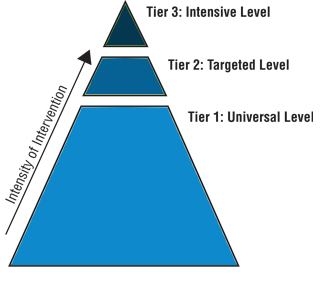
TIER 1: UNIVERSAL
For most students, if implemented successfully, this tier will be enough support for them to be successful.
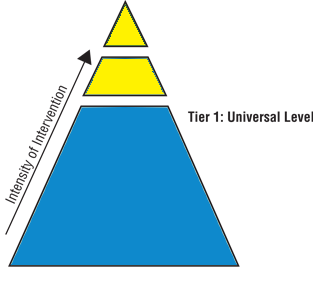
PBS begins with Tier 1, a school-wide system of universal, preventative strategies. Even if your school is not implementing a school-wide behavior system, you can and should implement a classroom system to support positive behaviors. If consistently and accurately implemented, these strategies will be enough to support 80% of students with behavior and academics.
Examples of Tier 1 Strategies
Implement Clear Expectations
With students, develop and sustain a classroom culture that is conducive for learning and fosters a climate of acceptance, respect, and high expectations.
Examples of Tier 1 Strategies
Implement Clear Expectations
With students, develop and sustain a classroom culture that is conducive for learning and fosters a climate of acceptance, respect, and high expectations.

Discuss and make clear school-wide behavioral expectations
- What are behaviors that will represent and support those rules? In the classroom? On the playground? In other settings (cafeteria, auditorium)? In after-school extra-curricular activities?
- Create a Rules-Within-Routines Matrix to display around this discussion and decision. (link to Rules-Within-Routines Matrix) This matrix will specifically outline what each expectation looks like across environments.
- Model and practice performing those behaviors, especially at the beginning of the school year. Continue with this modeling and practice throughout the year, particularly after breaks and/or as the class appears to need reminders and more practice.
- Add to, edit, and revise your Rules-Within Routine Matrix throughout the year to ensure it reflects the challenges faced in different environments, including field trips or special events.
- Engage the students so they are collaborating to develop the expectations, instead of having the rules come as a directive from the teacher. Ask: “How do we want our classroom to function so that we can all learn, feel safe, and feel accepted?”*Regardless of if your school is implementing a School-Wide Positive Behavior System, you can and should engage in this activity of developing class rules and expectations.
- Define the specific behaviors and expectations as a class.
- Model and practice performing those behaviors (lining up, cleaning up, getting out materials for a writing lesson, etc). As with learning a new musical instrument, it takes time and practice to demonstrate and master; a one time explanation of how to play the chord is not enough. Be clear that the same holds true for behavior! If students are not demonstrating the appropriate behavior, they will need more practice with it.
- Create a Rules-Within-Rules Matrix to display around this discussion and decision. (link to Rules-Within-Rules Matrix)
- Teach, model, and practice the expected behaviors throughout the year, particularly after breaks and/or as the class appears to need reminders and more practice. Conduct practice as just that--practice, not punishment.
- In particular, develop and practice transitions within the class (from subject to subject) and within the school (from place to place), as transitions are often a time when misbehavior occurs because of perceived downtime and unclear expectations.
- Modeling is most effective when the model is somehow connected to the student, for example they look up to their peer, the student is the same gender, or is in the same social group.
- Video modeling is a well researched strategy in which the student watches a video of the skill or behavior they are working on, and then work to imitate that behavior. The visual models enhance student understanding and are highly motivating. Video Modeling has been shown to be especially effective when working with children with autism on skills such as daily living, communication, social skills, academics, and reducing aggressive behavior; the use of videos is also more likely to help generalize the skill to different environments, as well as maintain that skill in the future.

References:
Banda, D.R., Matuszny, R.M., & Turkan, S. (2007). Video modeling strategies to enhance appropriate behaviors in children with autism spectrum disorders.
Teaching Exceptional Children 39(6), 47-52. doi: 10.1177/004005990703900607
Chandler, L. & Dahlquist, C. (2010). Functional assessment: Strategies to prevent and remediate challenging behaviors in school settings. London:
Pearson.
Denton, P. & Kriete, R. (2000). The first six weeks of school. Turner Falls, MA: Northeast Foundation for Children.
Kerr, M. & Nelson, C.M. (2010). Strategies for addressing behavior problems in the classroom (6th Ed). Upper Saddle River, NJ: Pearson/Merrill
Prentice-Hall.
Resources:
Engage Students
Instruction & Tasks
Provide meaningful instruction and learning activities that require students to use their critical and creative thinking skills.
Banda, D.R., Matuszny, R.M., & Turkan, S. (2007). Video modeling strategies to enhance appropriate behaviors in children with autism spectrum disorders.
Teaching Exceptional Children 39(6), 47-52. doi: 10.1177/004005990703900607
Chandler, L. & Dahlquist, C. (2010). Functional assessment: Strategies to prevent and remediate challenging behaviors in school settings. London:
Pearson.
Denton, P. & Kriete, R. (2000). The first six weeks of school. Turner Falls, MA: Northeast Foundation for Children.
Kerr, M. & Nelson, C.M. (2010). Strategies for addressing behavior problems in the classroom (6th Ed). Upper Saddle River, NJ: Pearson/Merrill
Prentice-Hall.
Resources:
- Establishing Classroom Rules
- Video Modeling: Watch Me Learn
- Steps for Implementing Video Modeling
- Classroom Schedules/Routines (Pinterest)
- Rules Within Routines Matrix (PDF)
- Rules Within Routines Matrix (DOCX
Engage Students
Instruction & Tasks
Provide meaningful instruction and learning activities that require students to use their critical and creative thinking skills.
- Differentiate how students receive content, how they engage in the learning process, and how they demonstrate their learning via a product, following the principles of Universal Design for Learning (UDL).

- Integrate technology
- Vary learning experiences: Small group work gives students more opportunities to engage and get involved in their learning, which increases their on-task behavior. Students exhibit more disruptive behaviors during whole-class, teacher-led activities.
- Avoid worksheets, busy work, and downtime. Always provide students with more work to engage with, more learning to achieve, so they do not become bored and feel the need to entertain themselves--or others! Students can always be reading a book, working on a project, or writing for an assignment.
Choice is a way to allow students more control in regards to what they are learning, as well as how they are learning it. In addition, choice increases student engagement and motivation, and results in a classroom that is focused on the co-construction of knowledge, instead of relying on the teacher as the source of all knowledge.
- Make sure the choices are feasible and fit into the goals of the activity/assignment.
- Choices should be clear, structured, and minimized (2-3 options maximum).
- Be clear about the expectations: “Here are the three learning activities you’ll be working on today. You can do them in whatever order you want.” Keep students accountable and on task by having them identify what they are working on (using a class chart or a personal organizer, which could be as simple as a post-it with the tasks written in order of how they would like to proceed).
- Assist students in this decision making by teaching time management and task organization.
- When working with a student who is resistant to work completion, giving them choice can have a positive impact on the on-task behavior.
Increase the rate of students’ opportunities to respond in order to maximize student engagement. These types of activities encourage students to participate in a variety of ways, going beyond just verbal participation. In addition, teachers can use this as a formative assessment, to see what learning has occurred and what instruction still needs to occur, and with whom.
- Students can respond to prompts or questions using student response cards, (true/false, often color coded, or a/b/c/d), which helps to engage all students as the entire class is responding to each question, instead of just one child per question.
- Response cards can also be visual, to support learners who rely on visual input for understanding, including pre-readers, struggling readers, and English Language Learners.
- Turn & Talk provides students with a partner with whom to share their comments and questions.
- Gauge understanding by asking students to show a thumbs up if they fully understand, or a thumb to the side if they are still unclear. This also provides students some autonymity and autonomy with their response.
- With individual white boards, students respond on their board and then display it for the teacher.

References:
Armstrong, T. (2000). Multiple intelligences in the classroom. (2nd Ed.) Alexandria, VA: Association for Supervision and Curriculum Development.
Bender, W. N. (2012). Differentiating instruction for students with learning disabilities: New best practices for general and special educators (3rd Ed.).
Thousand Oaks, CA: Corwin.
Boushey, G. & Moser, J. (2014). The daily five: Fostering independence in the elementary grades (2nd Ed.) Stenhouse.
Gregory, G.H. & Chapman, C. (2006). Differentiated instructional strategies: One size doesn’t fit all. (2nd ed.). Thousand Oaks, CA: Corwin Press.
Hall, T. E., Meyer, A., & Rose, D. H. (Eds.). (2012). Universal design for learning in the classroom: Practical applications. New York: Guilford Press.
Hallermann, S., Larmer, J., & Mergendoller, J. R. (2011). PBL in the elementary grades: step-by-step guidance, tools and tips for standards-focused k-5
projects. Novato, CA: Buck Institute for Education.
Kaplan, P., Rogers, V., & Webster, R. (2008). Differentiated instruction made easy. San Francisco: Jossey-Bass.
Larmer, J., Ross, D., & Mergendoller, J. R. (2009). PBL starter kit: To-the-point advice, tools and tips for your first project in middle or high school. Novato,
CA: Buck Institute for Education.
Riley, J. L., McKevitt, B., C., Shriver, M. D., & Allen, K. D. (2011). Increasing on-task behavior using teacher attention delivered on a fixed-time schedule.
Journal of Behavioral Education, 20, 149-162. DOI: 10.1007/s10864-011-9132-y.
Simonsen, B., Little, C. A., & Fairbanks, S. (2010). Effects of task difficulty and teacher attention on the off-task behavior of high-ability students with
behavior issues. Journal for the Education of the Gifted, 32(2), 245-260.
Resources:
- Choice Boards:
- More Voice/Choice:
- Video on using Response Cards
- Printable Response Cards:
- Best Technological Ways to Increase Engagement in Classroom
- 5 Reasons Technology in the Classroom Engages Students Article
- Kahoot it! Online review game
- Plicker Application
- PollEv Presenter
Reinforce and Reward Appropriate/Desired Behavior
Behavior-Specific Praise Comments
Praise desired behavior explicitly (“I notice and appreciate how you’re completing your assignment with your table mates”) instead of a general positive statement (“You’re doing great!”) or a negative statement (“You’re not getting your work done again.”)

Praise and Ignore Approach
Redirection
Instead of pointing out the inappropriate behaviors of the student, provide them specific guidance and instruction to change the behavior and get back on-task.
Extinction
Ignore the difficult behavior; the behavior may increase before decreasing, so stick to the plan!
- When the behavior of a student is to gain your attention, this approach may work for the negative behavior.
- Give more positive praise to the student when they are following class expectations
Redirection
Instead of pointing out the inappropriate behaviors of the student, provide them specific guidance and instruction to change the behavior and get back on-task.
Extinction
Ignore the difficult behavior; the behavior may increase before decreasing, so stick to the plan!
- Purposefully ignore the undesired behavior. Praise the student for on-task/appropriate behavior and gently redirect for off-task behaviors. If student is engaging in the behaviors to receive attention, they will no longer be successful. Instead, positive, expected behaviors will result in attention from the teacher.
- This is very difficult! Ignoring problematic behaviors may seem to be an implicit approval of or acceptance of those behaviors, and teachers often feel like other students will then engage in similar inappropriate behavior. This is why ignoring the inappropriate behaviors needs to be paired with reinforcement of positive behaviors.

References:
Alberto, P. A. & Troutman, A. C. (2009). Applied behavior analysis for teachers. Upper Saddle River, NJ: Pearson.
Austin, J. L., & Soeda, J. M. (2008). Fixed-time teacher attention to decrease off-task behaviors of typically developing third graders. Journal of Applied
Behavior Analysis, 41, 279-283. doi: 10.1901/jaba.2008.41-279
Resources:
General Tips & Basic Strategies
Allow for movement (fidget toys, doodling, knitting). Students can still pay attention, and may be able to actually focus better when their bodies are moving. Allow students to work and sit in various parts of the classroom (work standing up, cross-legged on the floor with clipboards, tablets, lying on the floor), as sitting feet flat on the floor at a desk is not conducive for learning and working for everyone. Teach students the expected behavior first (model it, have them practice multiple times) and be clear about expectations for work completion. Avoid power struggles, which often occur after the request of a teacher.

Make your redirection statement/statement of expectation (which students will already know because of your explanation, modeling, and teaching of classroom rules and consequences). “You know what is expected. Take your time to compose yourself and then take care of X so you can rejoin our learning.” Avoid eye contact, look away, and walk away. Give the student a moment to regain composure.
Proximity
Strong teachers are constantly adjusting their proximity to students during a lesson. Staying active and moving around the room is a great classroom management tool as it keeps students accountable to the classroom expectations. If you anticipate off-task behavior, physically moving yourself closer to the students who may struggle can help avoid difficult behavior. When behavior begins to escalate, seating yourself (or a classroom support person), near students that are struggling can often be enough to get them back on task. Solicit extra staff support or volunteers (adults, older peer mentors) for the classroom to sit within close proximity of a student to improve behavior.
Token Economy
In a token economy, tokens are used (points, chips, tickets) and paired with a reinforcer (rewards, privileges, special events) that a student can purchase or trade in for a specific amount. When a token is given, it is important to give specific encouragement to the student in regards to what they did to earn the token. Verbal feedback should be timely, positive, and specific to the positive behavior. Token economies work well when there are a variety of strategies to reward positive behavior. If a student is not responding to the reward system it is important to consider:
Contingency Contracts (Independent)
A contingency contract is an agreement between a student and teacher, which outlines a specific behavioral expectation. The contract includes a menu of reinforcers. When the student meets the expectation, they receive a reward/reinforcer.
General guidelines include giving the student an understanding of what a contract is, collaboratively working to develop the contract, involving all members who may be a part of implementation, setting a time frame to review and update the contract, and signing the contract to make it official.
Group Contingencies (Interdependent)
A group contingency focuses as a group (small group, table group, or class) to increase a positive behavior/reduce a specific problem behavior. The goal, and the specific reward, is set by the group.
If the goal of the group contingency is positive peer interactions, then the group receives a reinforcer when individual students make a positive comment; in this way, students are supporting each other to behave appropriately. (For example, I will put a tally up every time I hear a student making a positive comment to another student. When twenty positive comments have been made by the group, the class earns 20 minutes of extra technology time).
Proximity
Strong teachers are constantly adjusting their proximity to students during a lesson. Staying active and moving around the room is a great classroom management tool as it keeps students accountable to the classroom expectations. If you anticipate off-task behavior, physically moving yourself closer to the students who may struggle can help avoid difficult behavior. When behavior begins to escalate, seating yourself (or a classroom support person), near students that are struggling can often be enough to get them back on task. Solicit extra staff support or volunteers (adults, older peer mentors) for the classroom to sit within close proximity of a student to improve behavior.
Token Economy
In a token economy, tokens are used (points, chips, tickets) and paired with a reinforcer (rewards, privileges, special events) that a student can purchase or trade in for a specific amount. When a token is given, it is important to give specific encouragement to the student in regards to what they did to earn the token. Verbal feedback should be timely, positive, and specific to the positive behavior. Token economies work well when there are a variety of strategies to reward positive behavior. If a student is not responding to the reward system it is important to consider:
- Do they need rewards that are more motivating?
- Do they need to be rewarded on a more consistent schedule?
- The use of activity reinforcement is another great addition to a token economy. Activity reinforcement involves giving the opportunity for students to use their tokens to participate in a preferred activity (swinging on the swing, reading a comic, using technology), or a preferred whole-class activity (party, extra recess).
Contingency Contracts (Independent)
A contingency contract is an agreement between a student and teacher, which outlines a specific behavioral expectation. The contract includes a menu of reinforcers. When the student meets the expectation, they receive a reward/reinforcer.
General guidelines include giving the student an understanding of what a contract is, collaboratively working to develop the contract, involving all members who may be a part of implementation, setting a time frame to review and update the contract, and signing the contract to make it official.
Group Contingencies (Interdependent)
A group contingency focuses as a group (small group, table group, or class) to increase a positive behavior/reduce a specific problem behavior. The goal, and the specific reward, is set by the group.
If the goal of the group contingency is positive peer interactions, then the group receives a reinforcer when individual students make a positive comment; in this way, students are supporting each other to behave appropriately. (For example, I will put a tally up every time I hear a student making a positive comment to another student. When twenty positive comments have been made by the group, the class earns 20 minutes of extra technology time).

References:
Carr, J. E., Fraizer, T. J., & Roland, J. P. (2005). Token economy. Encyclopedia of behavior modification and cognitive behavior therapy, 2, 1075-1079.
Kerr, M.M., and Nelson, C.M. (2012). Strategies for Addressing Behavior Problems in the Classroom. Pearson Education Inc., New Jersey.
Resources:
Carr, J. E., Fraizer, T. J., & Roland, J. P. (2005). Token economy. Encyclopedia of behavior modification and cognitive behavior therapy, 2, 1075-1079.
Kerr, M.M., and Nelson, C.M. (2012). Strategies for Addressing Behavior Problems in the Classroom. Pearson Education Inc., New Jersey.
Resources:
TIER 2: TARGETED
This tier is for students who display at-risk behavior and minor rule violations
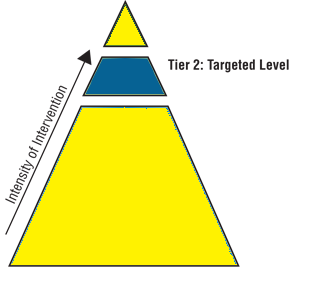
While the universal strategies will assist most students, 20% of them will need more support. This next level of support, Tier 2 - Targeted, is added to the supports of the Universal Tier and may be implemented in whole classes, small groups, or individually. This second tier, Targeted Interventions, will be successful for 15% of those students.

Examples of Tier 2 Strategies
- Check in, Check Out System (Daily Behavior Report Card)
- Social Skills Instruction
- Mentoring
- Sensory Tools
- Data collection on behaviors to understand function of the behavior
- Off-Task Behaviors
- Repetitive Behaviors
- Self-Monitoring with Rewards <- See Tier 2: Targeted - Repetitive/Stereotypic/Self-Stimulatory Behaviors
- Response Interruption and Redirection (RIRD) <- See Tier 2: Targeted - Repetitive/Stereotypic/Self-Stimulatory Behaviors
- Toy/Book Conditioning <- See Tier 2: Targeted - Repetitive/Stereotypic/Self-Stimulatory Behaviors
TIER 3: INTENSIVE
This tier is for students who exhibit serious rule violations and are a danger to self or others.
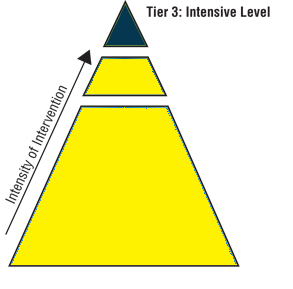
The remaining 5% of students for whom Tiers 1 and 2 are not enough will require more intensive interventions and support, which are added to the already implemented supports of the universal and targeted tiers. Tier 3 - Targeted will require multiple team members with varying areas of expertise to implement.
Example of Tier 3 Strategies:
Research-Based Strategies:
Repetitive/Stereotypic/Self-Stimulatory Behaviors
Example of Tier 3 Strategies:
- Behavior Contract
- Daily Behavior Report Card
- Functional Behavior Assessment (FBA)
- Behavior Intervention Plan (BIP)
- Direct Treatment Protocol (DTP)
Research-Based Strategies:
Repetitive/Stereotypic/Self-Stimulatory Behaviors
- humming
- nonsense words
- sounds, phrases, or echolalia
- flapping of hands
- finger flexing
- rocking of body

Repetitive behavior can be either vocal or motor based, and refers to behaviors that seem to lack a social function or motivation; however, these behaviors may in fact be meeting a need for the student (sensory regulation, increasing wait time for processing, attempting communication). There is evidence to support that reducing repetitive behavior in students can increase engagement and communication skills of the student.
Vocal behaviors may include humming, nonsense words, sounds, phrases, or echolalia (immediate repeating of words/phrases heard in their environment or delayed repetition of phrases from movies/other media). Motor behaviors may include flapping of hands, finger flexing, or rocking of body.
Self-Monitoring with Rewards
This strategy can be used with students who engage in repetitive verbal behavior (verbal stereotypy), that seems to serve no communication function. Student is taught to identify “quiet” vs “noisy” behavior. Student is given a “quiet” visual reminder, and self-records whether or not he/she has been quiet during the time interval. Student receives rewards for reaching a goal percentage of quiet intervals.
How to:
Understanding the Behavior: First, understand how often the child is engaging in the behavior (Phase 1: Baseline)
Vocal behaviors may include humming, nonsense words, sounds, phrases, or echolalia (immediate repeating of words/phrases heard in their environment or delayed repetition of phrases from movies/other media). Motor behaviors may include flapping of hands, finger flexing, or rocking of body.
Self-Monitoring with Rewards
This strategy can be used with students who engage in repetitive verbal behavior (verbal stereotypy), that seems to serve no communication function. Student is taught to identify “quiet” vs “noisy” behavior. Student is given a “quiet” visual reminder, and self-records whether or not he/she has been quiet during the time interval. Student receives rewards for reaching a goal percentage of quiet intervals.
How to:
Understanding the Behavior: First, understand how often the child is engaging in the behavior (Phase 1: Baseline)
- Identify examples of repetitive behavior (repeating words over and over) in contrast to typical and expected communication (answering a question).
- Collect data on how often the repetitive behavior is occurring.
- Provide a visual to support their understanding (picture of person representing quiet). Student may practice by first noting the behavior of others.
- Prompt student to notice their own behavior and provide reward when it is correctly noticed (with an emphasis on quiet/calm behavior).
- Once this is accomplished, teach the student to use the self-monitoring form.
- Student practices: “Get ready and show me quiet,” and is prompted to fill out the form. Teacher asks, “Were you quiet or noisy? That’s right, you were quiet (make sure the box is checked).”
- Correct the child if the incorrect box is checked, and when the student is not meeting the expectation a prompt can be used. Teacher says: “That’s noisy, show me quiet. Much better, that’s quiet.”
- During training, student can be rewarded for filling out their self-monitoring form correctly (recognizing the behavior).
- Then, the student can be rewarded for following the expectation of being quiet.
- Rewards may be immediate (a small edible for a quiet interval), or may be worked towards more long term (earned toy for 8/10 intervals being quiet).
- With practice, students can also be taught to reward themselves after each period of time that the goal is met.
- The self-monitoring form can be used to track behavior changes over time as well as the success of the intervention itself.
- Once the student is able to independently use the self-monitoring form, it important to monitor the accuracy with which the student records their behavior.
- Periodic check-ins to collect and compare data alongside the student and to calibrate progress monitoring which will give the student continued support.
- Review the examples of repetitive behavior (repeating words over and over) in contrast to typical and expected communication (answering a question) that were established during the baseline, to ensure consistent data collection methods and fidelity to the intervention.

Reference:
Mancina, C., Tankersley, M., Kamps, D., Kravits, T., & Parrett, J. (2000). Brief report: Reduction of inappropriate vocalizations for a child with autism using
self-management treatment program. Journal of Autism and Developmental Disorders, 30(6), 599-606.
Resources:
Self-Monitoring Form (PDF)
Self-Monitoring Form (DOCX)
Elopement/Running Away
Elopement is often referred to as running away, bolting, wandering, AWOL, or being out of bounds.Running away is a serious behavior to address due to the dangers that may occur for students without direct adult supervision. Elopement--the term used in research articles--can be defined as leaving the designated area without permission, and can be based upon a specific boundary (leaving the classroom), or based on a specific measurement (3-6 feet away).
Mancina, C., Tankersley, M., Kamps, D., Kravits, T., & Parrett, J. (2000). Brief report: Reduction of inappropriate vocalizations for a child with autism using
self-management treatment program. Journal of Autism and Developmental Disorders, 30(6), 599-606.
Resources:
Self-Monitoring Form (PDF)
Self-Monitoring Form (DOCX)
Elopement/Running Away
Elopement is often referred to as running away, bolting, wandering, AWOL, or being out of bounds.Running away is a serious behavior to address due to the dangers that may occur for students without direct adult supervision. Elopement--the term used in research articles--can be defined as leaving the designated area without permission, and can be based upon a specific boundary (leaving the classroom), or based on a specific measurement (3-6 feet away).

The severity of elopement may vary from a milder version (running from classroom) to more extreme (leaving campus or otherwise being out of sight for an extended period). Students may elope during transition times and avoid specific environments; the main concern--beyond safety--is that the student is missing instruction.
How do I pick an intervention
It is important to note that in order to pick an appropriate strategy to address elopement/running, the function of the bolting behavior must be understood. This is the why of the behavior, and explains why the child is engaging in this behavior.
Teachers can collect observational data on the student’s behavior in order to understand why the behavior is taking place. This can help the teacher chose a strategy to meet the student’s need. When faced with extremely challenging behavior that requires more support, teachers may seek the expertise of a psychologist and/or a behaviorist to conduct a Functional Behavior Assessment.
When gathering data to inform your intervention choice or conducting an FBA, the below patterns may be seen when analyzing the Antecedent, Behavior, Consequence Chart (ABC). Although superficially, elopement may seem to be an avoidant behavior, as a child may be running away from something aversive, it must also be considered that they are attempting to gain something else, such as access to an item, or teacher/staff attention.
It is important to note that in order to pick an appropriate strategy to address elopement/running, the function of the bolting behavior must be understood. This is the "why" of the behavior, and provides a reason that the child is engaging in this behavior.
Escape
Student bolts when frustrated with an assignment, peer, or other school-related issue. The behavior is reinforced through the elopement itself, as the child removes him/herself from the situation that is causing stress or difficulty.
Gain Access
Student elopes in search of something preferred, like an item, or a person. The behavior may be reinforced, even if the student gets access to the item/person for a brief period of time.
Attention
Student may bolt when he/she is left to work independently, and without immediate access to teacher support. Student gains access to this support through elopement, which reinforces the behavior.
Building Incremental Success: Graduated Exposure and Contingent Rewards
This intervention is useful for students who have an aversion to a specific place or activity (ie. PE class, assembly), and therefore elope from those environments. The goal is to slowly support them in reaching specific distance goals along the way (ie. half way to PE class, ¾ of the way), and rewarding them for doing so with a reinforcer (sticker, gum) and verbal praise. The distance is gradually increased (based on success), until the student is able to enter the environment. The goal then moves to participating and completing the expected tasks within the learning environment.
How to:
First, understand the behavior (Phase 1: Baseline):
First, measure how close the student will come to the setting without displaying negative behaviors (bolting, aggression).
Using this data, determine specific shorter distances along the way, where the student will be rewarded (the first reward being prior to the distance that the first negative behavior was exhibited, such as 30% of the closest distance the student achieved prior to displaying behaviors). Support the student in successfully reaching the first, closer goal multiple times before moving to the next expected distance, gradually reaching the goal location.
Next, work to get the student safely to the setting:
Then, work to get the student to enter the setting:
Finally, work to get the student to participate:
How do I pick an intervention
It is important to note that in order to pick an appropriate strategy to address elopement/running, the function of the bolting behavior must be understood. This is the why of the behavior, and explains why the child is engaging in this behavior.
Teachers can collect observational data on the student’s behavior in order to understand why the behavior is taking place. This can help the teacher chose a strategy to meet the student’s need. When faced with extremely challenging behavior that requires more support, teachers may seek the expertise of a psychologist and/or a behaviorist to conduct a Functional Behavior Assessment.
When gathering data to inform your intervention choice or conducting an FBA, the below patterns may be seen when analyzing the Antecedent, Behavior, Consequence Chart (ABC). Although superficially, elopement may seem to be an avoidant behavior, as a child may be running away from something aversive, it must also be considered that they are attempting to gain something else, such as access to an item, or teacher/staff attention.
It is important to note that in order to pick an appropriate strategy to address elopement/running, the function of the bolting behavior must be understood. This is the "why" of the behavior, and provides a reason that the child is engaging in this behavior.
Escape
Student bolts when frustrated with an assignment, peer, or other school-related issue. The behavior is reinforced through the elopement itself, as the child removes him/herself from the situation that is causing stress or difficulty.
Gain Access
Student elopes in search of something preferred, like an item, or a person. The behavior may be reinforced, even if the student gets access to the item/person for a brief period of time.
Attention
Student may bolt when he/she is left to work independently, and without immediate access to teacher support. Student gains access to this support through elopement, which reinforces the behavior.
Building Incremental Success: Graduated Exposure and Contingent Rewards
This intervention is useful for students who have an aversion to a specific place or activity (ie. PE class, assembly), and therefore elope from those environments. The goal is to slowly support them in reaching specific distance goals along the way (ie. half way to PE class, ¾ of the way), and rewarding them for doing so with a reinforcer (sticker, gum) and verbal praise. The distance is gradually increased (based on success), until the student is able to enter the environment. The goal then moves to participating and completing the expected tasks within the learning environment.
How to:
First, understand the behavior (Phase 1: Baseline):
First, measure how close the student will come to the setting without displaying negative behaviors (bolting, aggression).
- Tell the student, “_____, it is time to go to the _____ (setting).” Walk with the student, until he/she displays behavior.
- Place a marker on the floor, to later measure the closest distance the student will tolerate.
- Tell the student, “It is time to go back to the classroom.”
- To calculate a meaningful baseline, get an average for the setting across multiple attempts (at least 3).
Using this data, determine specific shorter distances along the way, where the student will be rewarded (the first reward being prior to the distance that the first negative behavior was exhibited, such as 30% of the closest distance the student achieved prior to displaying behaviors). Support the student in successfully reaching the first, closer goal multiple times before moving to the next expected distance, gradually reaching the goal location.
- Possible rewards include small edibles (raisin, goldfish), or another small reward such as a sticker.
- Pair the reward with specific verbal praise, “Nice job walking safely.”
Next, work to get the student safely to the setting:
- A second staff person stands on the distance marker that sets the goal for the student.
- If the student reaches the marker, they receive their small reward, paired with verbal praise, and return to the classroom.
- If problem behaviors occur, no reward is given and the student is prompted to return to the classroom.
- When the student is successful at the distance two instances in a row, increase the distance 20%.
- Continue with these steps until the student is able to arrive at the setting, for three consecutive sessions.
Then, work to get the student to enter the setting:
- After three consecutive successes of reaching the doorway of the setting, the second staff person is now there to greet the student, and reward them for stepping into the environment.
- A timer is set once the student enters the setting, to cue the student how long they will remain in the setting. Once the timer goes off, the student is rewarded and then returns to class. If the student engages in negative behavior prior to the timer going off, the time and behaviors are recorded, and the student is prompted to return to class.
- The expectation for time spent in the setting is adjusted as needed, and may be set at as low as 2 seconds initially, and slowly built up with successes.
- As the student becomes more successful, the rewards will be faded out.
Finally, work to get the student to participate:
- Once the student is able to enter the setting, and remain in the setting for a meaningful amount of time, rewards are then switched to match participation goals.
- Student can be rewarded for a specific action (running one lap), or for being a part of the group for a specific amount of time (sitting in circle time for 3 minutes).
- As the student becomes more successful, rewards can shift to tokens, which can later be translated into larger rewards.

Reference:
Schmidt, J. D., Luiselli, J. K., Rue, H., & Whalley, K. (2013). Graduated exposure and positive reinforcement to overcome setting and activity avoidance in an
adolescent with autism. Behavior Modification, 37(1), 128-142. doi: 10.1177/0145445512456547
Resources:
Functional Communication Training (FCT)
FCT is a well researched strategy, which teaches students specific communication skills in order to meet their needs; essentially the elopement behavior is being replaced with positive communication skills. The student can make their request verbally (requesting an item or break) or in a nonverbal way, (pointing to the desired item or activity or using a cue card).
How to:
Schmidt, J. D., Luiselli, J. K., Rue, H., & Whalley, K. (2013). Graduated exposure and positive reinforcement to overcome setting and activity avoidance in an
adolescent with autism. Behavior Modification, 37(1), 128-142. doi: 10.1177/0145445512456547
Resources:
Functional Communication Training (FCT)
FCT is a well researched strategy, which teaches students specific communication skills in order to meet their needs; essentially the elopement behavior is being replaced with positive communication skills. The student can make their request verbally (requesting an item or break) or in a nonverbal way, (pointing to the desired item or activity or using a cue card).
How to:
- First, understand the level of communication:
- The child’s communication level must be understood. In order for FCT to work, the communication training must be centered on their level of functioning.
- Verbal training can vary from simple one word statements (“break”), to more complex sentences (“I need a break on my beanbag”).
- Some students with limited language may require non-verbal strategies such as PECS. Regardless of the student’s communication level, when students are stressed their communication abilities may be limited. Therefore, it may be meaningful to have nonverbal choices (cue card, symbols or sign language).
- In order to respect the student’s need for privacy, a previously agreed upon phrase, sign, or symbol can be established, while still providing them a more positive means to communicate.
- Use the ABC chart to collect data regarding the antecedents that occur prior to the elopement. This information will help to create the phrases that the student can be taught to use to get what they need, instead of running away.
- Establish why the student is running away (function of the behavior): was the child attempting to gain something, such as access to a toy or access to adult attention? Or was the child trying to avoid something, such as classwork, or interaction with peers? Based on the function, the focus of the FCT training will vary.
- Once the function of the behavior is established, specific communication is taught using sentence frames or phrases, so the student is able to ask for what he/she needs, instead of running away.
- Data should be collected regarding the student’s maximum ability to engage in a specific task or subject matter. For example, how long can he/she engage in the math lesson before eloping from the task? Or, how many minutes of assembly can the student attend before eloping? The focus of the data collection should be on the content areas with which the student struggles.
- It is important to teach students the functional communication skills before they begin to engage in the undesirable behavior. This can be practiced during calm/successful times of day.
- Prompt students to use their verbal phrases or may be given the choice to use symbols, sign language, or PECs.
- Students should be prompted to use their words prior to reaching their “maximum.” For example, if a student can participate in a writing task for only 10 minutes before running away, prompt them at 8 minutes to ask for a break.
- More prompts are needed initially, such as “Do you need a break?” and later as the student is able to use their phrases more consistently the prompts can be less specific, “What do you need right now?”
- If the student successfully requests the break prior to eloping, the student is given immediate access to fulfill the request.
- As the child is more successful, the tasks become longer and the prompts are faded. The child may be prompted more generally, “What do you want?”

References:
Carr, E. G., & Durand, M. (1985). Reducing behavior problems through functional communication training. Journal of Applied Behavior Analysis, 18(2),
111-126. doi: 10.1901/jaba.1985.18-111
Piazza, C.C., Hanley, G.P., Bowman, L.G., Ruyter, J.M., Lindauer, S.E., & Saiontz, D.M. (1997). Functional analysis and treatment of elopement. Journal of
Applied Behavior Analysis, 30(4), 653-672. doi: 10.1901/jaba.1997.30-653
Tarbox, R.S.F., Wallace, M.D., & Williams, L. (2003). Assessment and treatment of elopement: A replication and extension. Journal of Applied Behavior
Analysis, 36(2), 239-244. doi: 10.1901/jaba.2003.36-239
Wacker, P.W., Lee, J.F., Padilla Dalamau, Y.C., Kopelman, T.G., Lindgren, S.D., Kuhle, J., . . . Waldron, D.B. (2013). Conducting functional communication
training via Telehealth to reduce the problem behavior of young children with autism. Journal of Developmental and PhysicalDisabilities, 25, 35-48.
doi: 10.1007/s10882-012-9314-0
Resources:
Positive-Attention: Non-Contingent Attention
This intervention is implemented for students who run away to get attention (being chased or the desire for one on one time with an adult). Instead, consistent, positive attention is given to the student while they are “in bounds” or in the expected area.
How to:Collect data regarding what triggers the behavior, and how the student is rewarded for the elopement. For example, does the student gain attention from peers? Does the student run away when he/she is left alone without adult support? Does the student show success with additional staffing support?
Implementation:
Carr, E. G., & Durand, M. (1985). Reducing behavior problems through functional communication training. Journal of Applied Behavior Analysis, 18(2),
111-126. doi: 10.1901/jaba.1985.18-111
Piazza, C.C., Hanley, G.P., Bowman, L.G., Ruyter, J.M., Lindauer, S.E., & Saiontz, D.M. (1997). Functional analysis and treatment of elopement. Journal of
Applied Behavior Analysis, 30(4), 653-672. doi: 10.1901/jaba.1997.30-653
Tarbox, R.S.F., Wallace, M.D., & Williams, L. (2003). Assessment and treatment of elopement: A replication and extension. Journal of Applied Behavior
Analysis, 36(2), 239-244. doi: 10.1901/jaba.2003.36-239
Wacker, P.W., Lee, J.F., Padilla Dalamau, Y.C., Kopelman, T.G., Lindgren, S.D., Kuhle, J., . . . Waldron, D.B. (2013). Conducting functional communication
training via Telehealth to reduce the problem behavior of young children with autism. Journal of Developmental and PhysicalDisabilities, 25, 35-48.
doi: 10.1007/s10882-012-9314-0
Resources:
- FCT Tracker (PDF)
- FCT Tracker (DOCX)
- Maximum Endurance Tracker (PDF)
- Maximum Endurance Tracker (DOCX)
- Functional Communication Training (FCT), Example (PDF)
Positive-Attention: Non-Contingent Attention
This intervention is implemented for students who run away to get attention (being chased or the desire for one on one time with an adult). Instead, consistent, positive attention is given to the student while they are “in bounds” or in the expected area.
How to:Collect data regarding what triggers the behavior, and how the student is rewarded for the elopement. For example, does the student gain attention from peers? Does the student run away when he/she is left alone without adult support? Does the student show success with additional staffing support?
Implementation:
- Non-contingent attention may vary depending on the student, depending on what type of attention they most desire. Attention is given to the student on a consistent schedule that may vary with age and need, beginning as often as every 30 seconds.
- Types of attention: specific verbal praise (“Thank you for being in your seat”), eye contact, high fives, or keeping close proximity with the student.
- When the student does engage in elopement, the behavior is responded to with the least amount of attention possible.
- Example: Face away from the student, minimize verbal engagement, and guide them towards the appropriate location, where they are given a time out (away from adult and student attention) in a safe place.
- The student can also benefit from Functional Communication Training (FCT), with a focus on prompts to gain attention, and should be practicing FCT skills as well, to decrease the behavior.

Reference:
Kodak, T., Grow, L., & Northup, J. (2004). Functional analysis and treatment of elopement for a child with attention deficit hyperactivity disorder. Journal of
Applied Behavior Analysis, 37(2), 229-232.
Resources:
Kodak, T., Grow, L., & Northup, J. (2004). Functional analysis and treatment of elopement for a child with attention deficit hyperactivity disorder. Journal of
Applied Behavior Analysis, 37(2), 229-232.
Resources:
- Collecting data: Antecedent/Behavior/Consequence (ABC)
- The Iris Center

Elopement/Running Away Resources:
Similar Behaviors:
- ABC Chart (PDF)
- Maximum Endurance Tracker (PDF)
- Eloping Tracker (DOC)
- Eloping Tracker (PDF)
- Eloping Intervention Tracker (DOC)
- Eloping Intervention Tracker (PDF)
- Functional Behavior Assessment (FBA) - Marin SELPA Form (DOC)
- Functional Behavior Assessment (FBA) - Marin SELPA Form (PDF)
- Functional Communication (FCT-Example of Mands) (PDF)
- Functional Communication (FCT) Tracker (PDF)
- IAN Report
Similar Behaviors:
PBS for Beginners - Where do I Start?
PBS is a school-wide system of universal, preventative strategies. The underlying theme is behavior is learned, therefore, behavioral expectations are taught in the same manner as any core curriculum subject.
PBS begins with a team of representative members of the school receiving training and identifying 3 to 5 behavioral expectations that are positively stated and easy to remember. In other words, rather than telling students what not to do, the school will focus on the teaching the preferred/positive behaviors.
The following suggestions and examples are from the Positive Behavioral Interventions and Supports website:
PBS begins with a team of representative members of the school receiving training and identifying 3 to 5 behavioral expectations that are positively stated and easy to remember. In other words, rather than telling students what not to do, the school will focus on the teaching the preferred/positive behaviors.
The following suggestions and examples are from the Positive Behavioral Interventions and Supports website:

Typically, a team of approximately ten representative members of the school will attend a two or three day training provided by skilled trainers. This team will be comprised of administrators, classified, and regular and special education teachers. The school will focus on three to five behavioral expectations that are positively stated and easy to remember. In other words, rather than telling students what not to do, the school will focus on the preferred behaviors. Here are some examples from other schools:
Consistency from class to class and adult to adult is very important for success implementation of PBS. The team will then create a matrix of what the behavioral expectations look like, sound like, and feel like in all the non-classroom areas. This matrix will have approximately 3 positively stated example for each area. Here is an example from one school:
- Respect Yourself, Respect Others, and Respect Property
- Be Safe, Be Responsible, Be Respectful
- Respect Relationships and Respect Responsibilities
Consistency from class to class and adult to adult is very important for success implementation of PBS. The team will then create a matrix of what the behavioral expectations look like, sound like, and feel like in all the non-classroom areas. This matrix will have approximately 3 positively stated example for each area. Here is an example from one school:
|
Description |
Cafeteria |
|
Restroom |
|
Playground |
|
Bus |
|
|
|


|
Marin County SELPA commissioned Dominican University of California’s Department of Special Education to identify evidence-based behavioral practices to support students, teachers, and local schools. In particular, the task was to identify positive, evidence-based classroom practices leading to academic and behavioral success.
Dominican University of California is located in Marin County and offers graduate programs that culminate in a Master of Science (MS) in Education degree. These programs are designed for educators and other professionals who are interested in teaching and seek preparation for leadership roles and responsibilities
|